Why so many pubs are called the White Hart: a king's badge on the inn sign
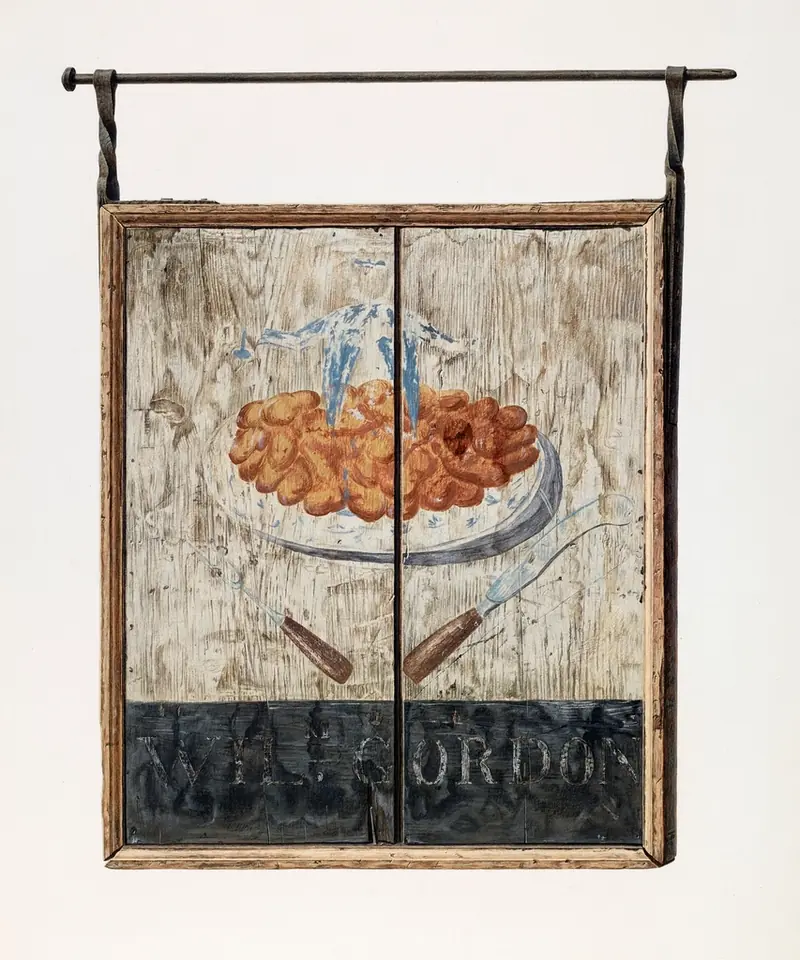
Illustrative painting: a painted tavern sign hanging from an iron bracket. Credits
Walk through almost any old market town in England or Wales and you will pass a White Hart, a Red Lion or a Crown. The Old White Hart on Llantwit Major's square shares its name with a great many inns, and the name is older and stranger than it looks. It goes back to a medieval king's personal badge, to a law about alehouse signs, and to a time when most drinkers could not read the name over the door but could recognise a picture.
What a hart is
"Hart" is an old English word for a stag, a mature male deer, and in particular a red deer. It survives in the heraldic vocabulary that describes coats of arms, and on a good many inn signs. A white hart is a rare animal in nature, and white stags have long carried a sense of the marvellous in European folklore and romance. In English folklore the white hart is also linked with Herne the Hunter, the antlered ghost of Windsor Forest.
On a pub sign, though, the white hart is not really a piece of folklore. It is a royal emblem, and it belongs to one king above all.
The badge of Richard II
The white hart was the personal badge of Richard II, who reigned from 1377 until he was deposed in 1399. He probably took it from the arms of his mother, Joan of Kent, known as "the Fair Maid of Kent"; some have also read it as a pun on his name, "Rich-hart".
In the late Middle Ages a badge was not quite the same thing as a coat of arms. Arms identified a family; a badge was a simpler device that a lord could hand out to servants, retainers and supporters, sewn on clothing or cast in metal. These "livery badges" showed whose side you were on. Richard gave white hart badges to a large private retinue of his own, and the badge became one of the most visible symbols of his rule. Livery badges in general were controversial at the time, because great lords used them to mark the private armies that enforced their will, and Parliament repeatedly tried to limit them.
The Wilton Diptych
The finest surviving image of Richard's badge is the Wilton Diptych, a small portable altarpiece painted on two hinged oak panels, now in the National Gallery in London. On the left panel the young king kneels, presented by saints, before the Virgin and Child on the right. Richard wears a gold and white enamel white hart jewel, his robe is patterned with white harts, and the angels around the Virgin all wear the same badge.
Close the diptych and the outside shows the emblem on its own: a white hart "lodged", the heraldic term for an animal lying down, on a grassy meadow, with a gold crown around its neck and a gold chain. The painting is widely described as the earliest authentic contemporary portrait of an English king, and it is the clearest picture we have of what a fourteenth-century white hart badge looked like.
If you see a white hart on a pub sign with a golden collar and chain, it is following the same heraldic pattern as the Wilton Diptych, whether or not the sign painter knew it.
A law that made pubs hang out a sign
Royal badges reached the high street through a practical rule. In 1393, during Richard II's reign, the law required anyone brewing ale to sell to put up a sign. The legislation is usually quoted as: "Whosoever shall brew ale in the town with intention of selling it must hang out a sign, otherwise he shall forfeit his ale."
The point was inspection. Local officials known as ale tasters, or ale conners, checked the quality and measure of the ale on sale, and a sign made alehouses easy to find. John Shakespeare, the playwright's father, was one of them. Quality control in pubs, in other words, is centuries older than the modern plaques you see by the door today (what the Cask Marque plaque means).
A sign had to be understood by people who could not read, so it was a picture rather than a word. Publicans chose images that everyone recognised, and few images were better known than the badges of kings and great lords.
From royal livery to the high street
The white hart became so popular as an inn sign during Richard's reign that later inns and taverns kept on adopting it long after his fall. It is one of a family of pub names that come straight out of heraldry:
- The Red Lion has several possible origins: the arms of a local landowner, the badge of John of Gaunt, or the lion of the Scottish royal arms, joined to those of England after 1603.
- The Blue Boar was the badge of the Earls of Oxford.
- The White Boar was the badge of Richard III.
- The White Horse is associated with the Hanoverian kings.
- The Rising Sun was a badge of Edward III.
- The Red Dragon stands for Wales.
Some of these names spread as signs of loyalty, others because a lord owned the land or the building, others simply because a name was familiar and a painter knew how to draw it. Once a name was established, it tended to stay: a pub sign was an address as much as an advertisement.
And the Old White Hart in Llantwit Major?
Nothing in the public sources we have consulted tells us when the inn on Llantwit Major's square took its name, or why. The building itself is older than any signboard you will see today: when the inn described itself online in the early 2010s, it said that parts of it dated back to the 15th century, which would make it roughly contemporary with the Town Hall across the square (a short history of the square).
The "Old" in the name is a common enough addition, used by many inns to stress their age or to distinguish themselves from a newer house of the same name. Without documents, it is better not to invent a link with Richard II himself. What can be said is that the inn belongs to one of the oldest families of pub names in Britain, and that the picture on its sign is, at its root, a fourteenth-century royal badge.
Reading pub signs today
Pub signs are still worth a second look. Many have been repainted dozens of times, and modern versions sometimes drift far from the heraldic original: a white hart may be shown leaping through woodland rather than lodged with its crown and chain. Others keep the old conventions faithfully. Next time you stop for a pint (how cask ale gets from the cellar to your glass), look up at the sign: it may be the oldest thing about the pub.
Sources
- White Hart (Richard II's badge, Joan of Kent and the Wilton Diptych)
- The National Gallery — The Wilton Diptych
- Pub (the 1393 law on alehouse signs and the ale tasters); heraldic pub names after Wikipedia's article on pub names