Pints, halves and two-thirds: the legal measures behind a British bar
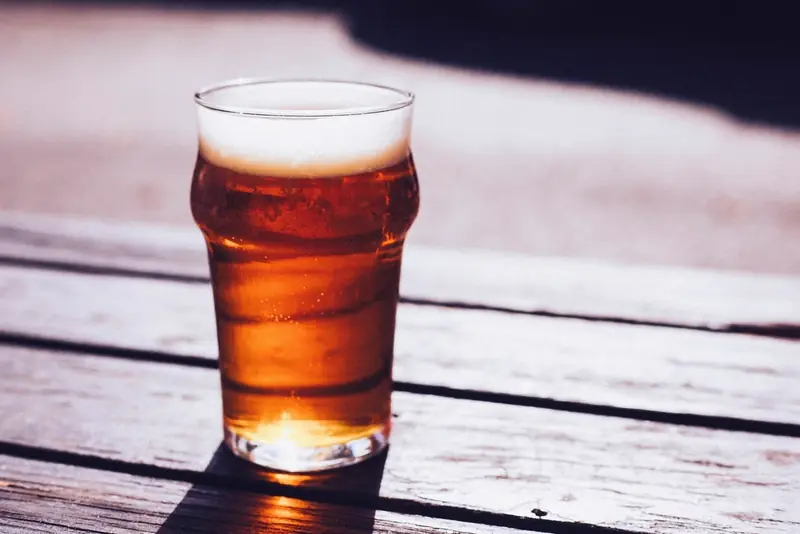
Illustrative photo: a pint of amber beer on a wooden table. Credits
Order a drink in a British pub and you are taking part in one of the most regulated small transactions in the country. The size of your beer, your whisky and your glass of wine is not left to the landlord's judgement or to local custom: it is fixed by law, and has been for generations. Much of the detail sits in a short statutory instrument that few drinkers have heard of, the Weights and Measures (Intoxicating Liquor) Order 1988. Here is what it says, and why the numbers on the bar look the way they do.
Draught beer and cider: thirds, halves and pints
Most goods in Britain are now sold in metric units, but draught beer and cider are among the few things still poured by the pint. An imperial pint is an eighth of a gallon, a little over 568 millilitres, noticeably more than the American pint.
The 1988 Order, made under the Weights and Measures Act 1985, sets out the quantities that are allowed. Unless it is pre-packed in a sealed container, beer or cider sold by retail must be sold only in a quantity of one third of a pint, half a pint, two thirds of a pint, or a multiple of half a pint. So a pint and a half or two pints are fine; three quarters of a pint, or a 500 ml "metric pint" from the tap, is not.
The rule applies to draught beer and cider whatever the type, from a cask ale pulled by hand pump to a keg lager. Two exceptions are worth knowing. The rule does not apply when beer or cider is sold as one ingredient in a mixture of two or more liquids, which is why a shandy or a "snakebite" can be poured to any size. And bottles and cans, being pre-packed, are outside it: the quantity printed on the label is what counts.
The two-thirds pint arrives
For most of the twentieth century the menu was simple: a third, a half, or a pint and its multiples. The two-thirds measure is a recent addition. It was added by the Weights and Measures (Specified Quantities) (Unwrapped Bread and Intoxicating Liquor) Order 2011, made on 19 September 2011 and in force from 1 October 2011, which amended the 1988 Order to insert two thirds of a pint into the list.
The new size, often nicknamed a "schooner" after the Australian glass, was welcomed by brewers of strong beers and by pubs and bars that wanted to offer a smaller serve than a pint without going down to a half. In practice it is most common in craft beer bars, where it suits stronger beers and tasting several in one visit. Many traditional pubs still keep to halves and pints.
Glasses, meters and the head
The Order also deals with how the quantity is measured. When beer or cider is sold for drinking on the premises, it must normally be served in a capacity measure of the quantity in question: in other words, a glass certified to hold a pint, a half, and so on. There is one alternative. The glass does not have to be a measure if the beer is measured by approved, stamped metering equipment, delivered straight from the meter into the glass after the customer has ordered it, with the equipment placed so that customers can see the delivery. That is why some bars pour through metered taps into unlined glasses.
The law does not spell out in the Order how much of a pint may be froth, and the question of the head has been argued over for decades by drinkers, brewers and trading standards officers. A tight, creamy head is part of the character of many cask and nitrogenated beers; a glass that is mostly foam is not what anyone ordered. If your pint looks short, the simple remedy is still the oldest one: ask politely for a top-up. A pub that cares about its beer, and perhaps displays a Cask Marque plaque, is unlikely to refuse.
Gin, rum, vodka and whisky: 25 or 35 ml
The Order treats four spirits separately: gin, rum, vodka and whisky. Sold for drinking on the premises, and unless pre-packed, they may be sold only in, or in a multiple of, one of two quantities: 25 ml or 35 ml. Three further conditions apply.
- One measure per house. The licensee must choose one of the two quantities and use it for all four spirits throughout the premises. A pub cannot serve whisky in 35 ml measures and vodka in 25 ml.
- A notice. A written statement showing which quantity is used must be displayed so that customers can see it before buying, without having to ask. It is often a small sign near the optics or on the drinks list.
- Cocktails are different. The rule does not apply when the spirit is one ingredient in a mixture of three or more liquids, and a customer can expressly ask for a different quantity in a mixture. A gin and tonic, with only two liquids, still uses the house measure.
The metric measures replaced older ones. The original text of the Order also allowed a quarter, a fifth or a sixth of a gill, the old imperial measure for spirits, but those quantities have not been permitted since 31 December 1994. Other spirits, such as brandy, liqueurs or tequila, are not on the list, so the law does not fix their measure in the same way, although many bars use the same optics for convenience.
Wine by the glass: 125 and 175 ml
Wine sold by the glass for drinking on the premises must be sold only in, or in a multiple of, 125 ml or 175 ml, and only if a written statement of the quantities is displayed or provided. That is why a "large" glass of wine in a pub is usually 250 ml: two measures of 125 ml. The current wording also comes from the 2011 Order. Two exceptions apply: a smaller tasting measure of less than 75 ml may be sold without the notice, and a customer may expressly ask for a mixture, such as a spritzer, in other quantities.
It is worth looking at the notice on the bar or the wine list before ordering. Many drinkers are surprised at how much wine a 250 ml glass holds: a third of a standard 75 cl bottle.
Why the rules exist
Fixed measures protect both sides of the bar. The customer knows what they are paying for and can compare prices from one pub to the next; the honest publican knows that a competitor cannot quietly serve smaller measures at the same price. Enforcement is the job of local trading standards officers, who can test measures and glasses.
Like the sign above the door (free house or tied pub?) and the hours on the licence (a short history of pub opening hours), the measures are one of those parts of pub life shaped by law long before the customer walks in. This guide does not publish the Old White Hart's drinks list or prices; as with any pub, the notices on the bar are the place to check.
Sources
- Weights and Measures (Intoxicating Liquor) Order 1988, SI 1988/2039, legislation.gov.uk, latest available text (article 2: beer and cider in thirds, halves, two-thirds and multiples of a half pint, mixtures and metered dispense; article 3: gin, rum, vodka and whisky in 25 ml or 35 ml, one quantity per premises, the written notice, the end of gill measures after 31 December 1994 and the exemption for mixtures of three or more liquids; article 5A: wine in 125 ml and 175 ml)
- Weights and Measures (Specified Quantities) (Unwrapped Bread and Intoxicating Liquor) Order 2011, SI 2011/2331, legislation.gov.uk (made 19 September 2011, in force 1 October 2011: the two-thirds pint and the new wording on wine by the glass)