Glamorgan sausages, Welsh rarebit and Caerphilly: the Welsh dishes on a pub menu
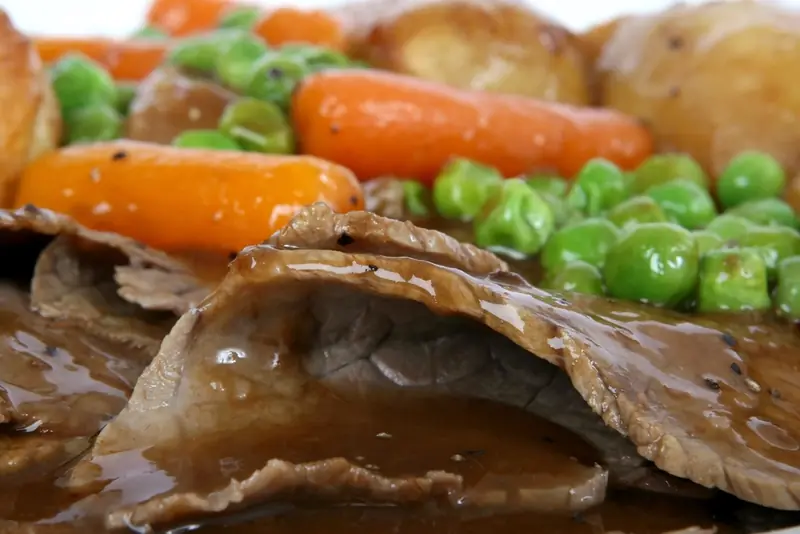
Illustrative photo: a roast dinner with carrots and peas. Credits
Pub menus in south Wales share most of their dishes with pubs across Britain: the Sunday roast, the pie, the ploughman's plate. A few items, though, are local, and the Vale of Glamorgan can claim one of them by name. Here is where the Glamorgan sausage, Welsh rarebit and Caerphilly cheese come from, what the records actually say about them, and what to expect when you see them chalked on a board.
The Glamorgan sausage: from pork to cheese and leek
Ask for a Glamorgan sausage today and you will be served something with no meat in it at all: a skinless roll of grated cheese, leek or spring onion and fresh breadcrumbs, bound with egg, seasoned with herbs and mustard, rolled in more crumbs and fried. It is one of the best-known vegetarian dishes of Welsh cooking, and one of the few vegetarian options with a long pedigree on a pub menu.
The earliest recipes tell a different story. A household notebook kept by John Perkins of Ty-draw, Llantrithyd, a village in the Vale near Cowbridge, now held at the Glamorgan Archives, contains a recipe from the years around 1795 to 1813 that calls for lean pork and fat, seasoned with sage, cloves and ginger. In the nineteenth century the name was used for pork sausages: a Cardiff pork butcher, Henry Hammond, advertised "Glamorgan sausages" in the Western Mail in December 1869, and his later advertisements praised their "choice dairy-fed pork".
The traveller George Borrow, touring the country in the 1850s for his book Wild Wales, ate sausages in a south Wales inn and judged them "not a whit inferior to those of Epping", a comparison with the skinless sausages of Epping, then famous in England. Which recipe he was served is not recorded.
How the cheese version took over is less well documented than the pork one. It is commonly linked to wartime rationing in the 1940s, when meat was scarce and a sausage that needed none had obvious appeal; it was certainly in circulation by the 1950s, when the Welsh Gas Board printed a recipe in one of its cookery books. The cheese itself has changed too. The original was probably Glamorgan cheese, made from the milk of the old Glamorgan breed of cattle, which almost died out; Caerphilly, a close relative in texture and taste, is the usual choice now.
What to expect on the plate
In a pub, Glamorgan sausages usually come in twos or threes, as a starter or as a main course with mash, chips or salad and a chutney or onion gravy. They are vegetarian rather than vegan, since the classic binding is egg and the cheese is a dairy product, although vegan versions now exist. If you are vegetarian and strict about rennet, ask which cheese the kitchen uses: many traditional hard cheeses are made with animal rennet.
Welsh rarebit, or Welsh rabbit?
The second Welsh classic is cheese on toast raised to a dish: a thick sauce of melted cheese, often made with ale or milk and seasoned with mustard and Worcestershire sauce, spread on toast and browned under the grill. It belongs on a pub menu almost by definition, since many cooks put beer in the sauce. A version topped with a poached or fried egg is sometimes called a "buck rarebit".
The name is older than the modern recipe. The earliest recorded form, from 1725, is "Welsh rabbit": a joke, since there is no rabbit in it, and probably a teasing one at the expense of the Welsh, whether it meant that Welsh people could not afford meat or simply that they were famously fond of cheese. That reputation was already old: a book of 1542 by Andrew Boorde has a Welshman declare his love of "good roasted cheese". Hannah Glasse's The Art of Cookery (1747) gives recipes for a Scotch rabbit, a Welsh rabbit and an English rabbit, each a slightly different way of toasting cheese and bread.
"Rarebit" appears later, in the 1780s, and is generally explained as a polite or mistaken respelling of "rabbit" rather than a separate word. Not everyone approved. The lexicographer H. W. Fowler, in 1926, called "Welsh Rabbit" "amusing and right" and "Welsh Rarebit" "stupid and wrong". Both forms are still in use, and you will see either on a menu.
Caerphilly: the cheese that left Wales and came back
Caerphilly is a white, mild, slightly salty and crumbly cow's-milk cheese named after the town north of Cardiff, best known for its castle. It is often said to have been made with miners in mind: a moist cheese that kept well underground and replaced some of the salt a manual worker lost in a shift. Whatever the truth of that, it was a farmhouse cheese of south Wales before it became an industrial one.
In the early twentieth century, competition for milk pushed much of its production over the border, and most mass-produced Caerphilly is still made in the West Country of England. During the Second World War cheesemaking was concentrated on a few standard hard cheeses, and Caerphilly production stopped for the duration. Farmhouse Caerphilly returned to Wales from the 1980s, made by small dairies such as Caws Cenarth in west Wales.
Since 2018 "Traditional Welsh Caerphilly" (in Welsh, "Traditional Welsh Caerffili") has been a protected geographical indication. The name was first registered under the European Union scheme, and it remains on the UK's own register of protected food names, where the product specification sets out how and where the cheese must be made: in Wales, to a traditional method. A plain "Caerphilly" without those words can still be made anywhere. On a cheeseboard, the young cheese is fresh and lemony; some makers also mature it, which gives a softer rind and a creamier layer under it.
Reading a Welsh pub menu
- Look for the place names. A Glamorgan sausage, a Caerphilly or a dish made with Welsh lamb or beef tells you something about the kitchen's sourcing, but only the menu or the staff can tell you where a given ingredient was bought.
- Ask about the cheese. It matters for vegetarians, and it is a fair question about a Welsh rarebit too: some kitchens use Cheddar, some Caerphilly, some a mixture.
- Match the beer. A rarebit made with ale and a pint of the same style is an old pairing. Our article on how cask ale is kept and served explains what is happening behind the hand pump, and pints, halves and two-thirds explains why your glass comes in those sizes.
- Bilingual menus. In Wales you may see Welsh names alongside English ones: caws is cheese, selsig sausages, and cawl the traditional broth of meat and vegetables.
The Old White Hart itself once advertised home-made specials, Sunday lunch and locally sourced produce, as described on our food and drink page; as ever, this guide does not publish its current menu or prices. If you are spending the day in town, Llantwit Major in a day suggests a walk that ends, sensibly, back on the square.
Sources
- Glamorgan sausage, Wikipedia (the John Perkins notebook of about 1795 to 1813 at the Glamorgan Archives, Henry Hammond's 1869 advertisement in the Western Mail, George Borrow's Wild Wales, the Welsh Gas Board recipe of the 1950s, Glamorgan cheese and the switch to Caerphilly)
- Welsh rarebit, Wikipedia (first record of "Welsh rabbit" in 1725, Andrew Boorde in 1542, Hannah Glasse's recipes of 1747, "rarebit" from the 1780s, H. W. Fowler in 1926)
- Traditional Welsh Caerphilly / Traditional Welsh Caerffili, UK protected food names register, GOV.UK (protected geographical indication and product specification; EU registration by Commission Implementing Regulation (EU) 2018/138)